Interview with Dana Malkus, 2026
This work is licensed under CC BY-NC 4.0


You may adapt, copy, and redistribute this material in any medium or format for noncommercial purposes, but you must credit the contributor(s) and Cementland Archive, include the above license information, and indicate if changes were made.

NO ALTERATION
02.12.26
Zoom call
Conversation with Danya Gerasimova
Edited by Danya Gerasimova
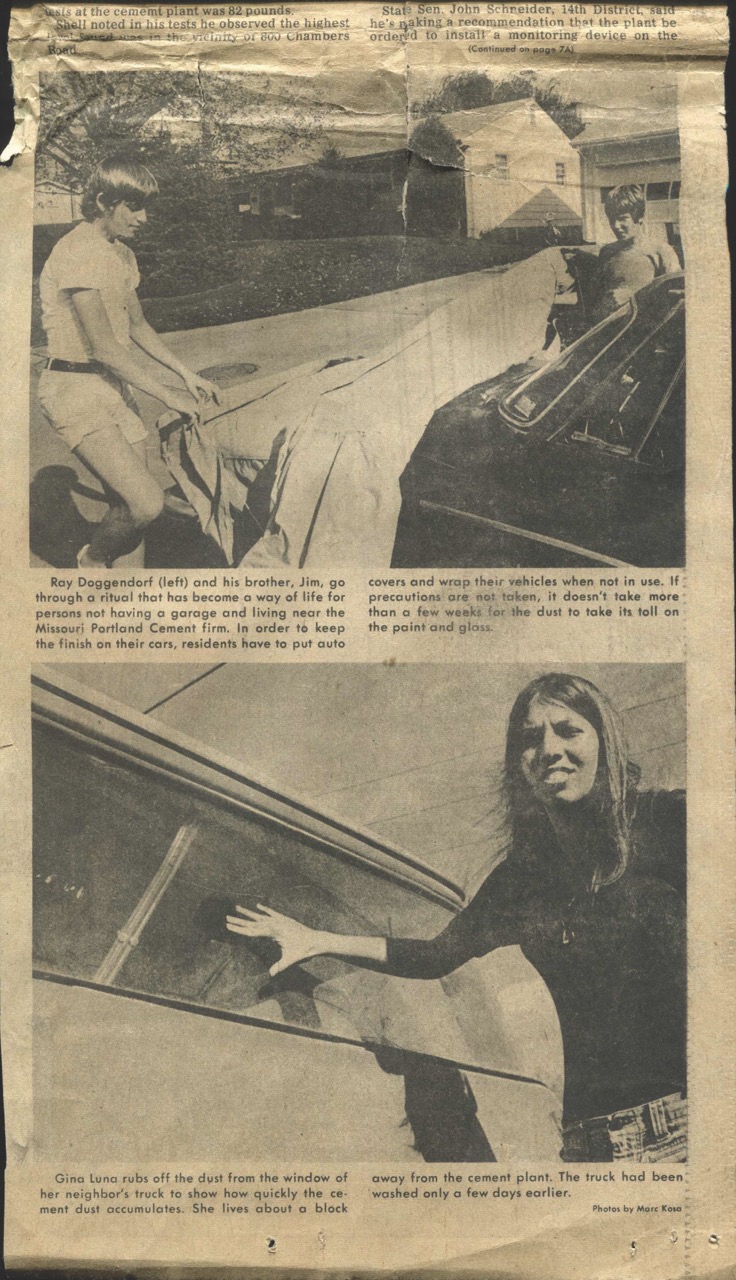
Dana Malkus is a professor at the St. Louis University School of Law and board secretary for the STL Vacancy Collaborative.
Danya Gerasimova:
Could you share a little about your work with the STL Vacancy Collaborative?
Dana Malkus:
Sure. I have been part of what we now call the STL Vacancy Collaborative since its very beginnings. The formal beginning was around 2018, although we came together informally for a couple of years before that. Originally, the Collaborative was a convener trying to pull together relevant stakeholders on the government, the nonprofit, and the resident sides. We were trying to raise awareness of the vacancy issue and help all of us see that there are tools we can use to deal with the problem. We're not powerless in the face of it. Neighborhoods and their residents actually have the power to deal with the problem as well [as the city government].
Over time, the Collaborative developed a lot of tools and data. That was one of the things we were missing in the beginning: we didn't have great ways of measuring anything to define the problem. Over time, we've developed resources intended to help stakeholders take action on vacant and abandoned property. Our most recent report was part of something called the Vacancy Strategy Initiative. During this initiative, we worked with the city [of St. Louis] to give recommendations for how to move forward from here. The report details what steps we think the city needs to take to move the needle on the vacancy challenge.
Vacancy is a really complex problem. It has a long and complex history, and requires a proactive and coordinated approach from both the public and private sectors. That's a really tall order, in our city especially. So our focus has been on awareness building, education, data, political will, and advocacy. I think all of those things are needed if we want to make an impact.
Danya Gerasimova:
Absolutely. Like we discussed before I started recording, our project revolves around Cementland. Cementland is listed as an empty lot on the vacancy mapping online tool published by the Collaborative. You said you've heard of Cementland before?
Dana Malkus:
Yes. I haven't spent any time there, but I've driven by it, and I know a bit from reading about it and from being connected to City Museum and the art world in St. Louis. But I don't know much. I'm not intimately familiar with it.
Danya Gerasimova:
We want to contextualize Cementland a bit more in its environment. It’s located near the edge of the Baden community in St. Louis city. Can you talk about how Baden compares to the rest of St. Louis in terms of vacancy?
Dana Malkus:
Baden is an interesting neighborhood because on one hand, it does have significant vacancy. It's not at the highest level of vacancy in the city, but it was hit really hard by the foreclosure crisis. As I said before, vacancy is a complex problem. One of the things that exacerbated the vacancy challenge in St. Louis was the foreclosure crisis. We're still feeling the effects of that.
One of Baden's advantages is that it has quality housing stock that is more manageable to rehab. So I think it historically has and continues to provide a lot of opportunities, especially for first-time home buyers. Baden is a bright spot in our city in terms of what can happen when residents come together to work on this challenge. Baden has a neighborhood group called the Revitalization of Baden Association, or ROBA. They've been working for several years now to repurpose abandoned houses for owner-occupiers through a homesteading program they're doing with Legal Services of Eastern Missouri. They're taking a really proactive approach in trying to repurpose the vacant properties there. I think Baden is an example of a neighborhood where there is certainly a challenge, but the residents are working to meet that challenge. It's really inspiring.
ROBA got a grant from the Vacancy Collaborative last year. These Vacancy to Vibrancy grants are small grants that can be used to reinvigorate a public space. We call these pocket parks. There's some information about that on our website. That's another way of reusing vacant property, even temporarily. Another example of making a difference, even in small ways. Neighborhood residents coming together can really change the narrative and change the perception of what's going on in their neighborhood.
.png)
.png)
Danya Gerasimova:
How is the state of vacancy in Baden different from the stretch of North Riverfront adjacent to Cementland, where there are fewer residential buildings and more industrial facilities?
Dana Malkus:
You've already really hit on it. When you're looking at vacancy, part of what you're looking at is what these places were originally designed for. Baden was designed to be a residential neighborhood. And when you look at North Riverfront, it's always been more of a mixed-use neighborhood, and there's been a lot of industrial use there. Like you pointed out, there are some larger tracts of property. So when those become abandoned, the situation becomes even harder. It's challenging to rehab even one vacant home, and that challenge gets magnified when you're trying to figure out a use for a much bigger piece of land.
I think that's the challenge in the North Riverfront. It's a real economic development kind of issue. With that, you need even more coordination, not only of the residents, but also the businesses and the local government. You need the city to be on board with having a plan and implementing that plan. I actually didn't know this before I was getting ready to talk to you, but there is what's called the North Riverfront Commerce Corridor Land Use Plan that was adopted by the Planning Commission back in 2013. It's on the city's website. The plan's purpose is to attract new businesses to the North Riverfront. I don't really know what's become of that plan. It's fairly dated now, but I would imagine that there are still some good nuggets in there.
And that is always the issue. You can have a plan, but you've got to have advocacy around implementing the plan, and you have to have some infrastructure to make it happen. But I do think that, as opposed to Baden, the reuse of North Riverfront is probably more industrial and business focused than residential.
Danya Gerasimova:
We got in touch with the current owners of Cementland, Beelman Trucking. They are a trucking company based in East St. Louis, and they purchased the property in 2022. We talked to them about a month ago, and they said that they have no current plans for the property, and they're not currently planning demolition or anything else. I'm wondering if you have any insight into how common this situation is with landowners in that area? Do you have any idea as to what the motivation or benefit might be?
Dana Malkus:
Great question. You could take a whole class just on that, and we could spend many hours talking about it, but several things come to mind. One is that in the St. Louis area that you're talking about, we have a very soft real estate market. We don't have the same kind of demand for those spaces as a more populated place would. We've been losing population. And so a lot of the work is figuring out what these areas can be reused for and if there is a market for that. I think that makes it pretty easy for investors or landowners to just hold on to land. If there's not a strong market, they will often hold it thinking that someday the market will recover and they will be able to make a lot of money from selling it to someone else.
You do see a lot of holding, and especially when the holding costs are relatively low, there's not a lot of incentive for anyone to do anything with those types of properties. And in our city, not unlike a lot of other cities, the holding costs are very low. You basically have to pay the taxes and maybe insurance. A lot of property owners don't even have insurance.
Now, there can be ways that holding costs can become more. For example, if you are violating the code. There are building codes in our city, and if you are violating those codes, you can be fined, which can increase the carrying costs a bit. If you're creating a nuisance, you could potentially be sued for that. But again, if you're just sitting on the property and it's really not violating any code or causing a nuisance, there often is not an incentive to do anything with it. Some of the strategies we talk about include the neighborhood or the community putting pressure on the owner to do something with the vacant and abandoned property. You can get to some good resolutions if there is advocacy from the people who are near the property and want to see something happening with it.
The bottom line is that we tend to have a lot of speculation because the holding costs are low. In the US, we are in a private property system. Private property rights are very culturally and institutionally strong here, and so there isn't as much consideration in the law or in the culture for the way that someone's private property might actually be impacting the neighborhood. We don't tend to think in those terms as much. We are a more individualistic culture and legal system, I think.
Danya Gerasimova:
Yeah, that makes a ton of sense. I know this is also a huge topic to discuss, but can you talk just a bit about why vacant properties can become a burden on the surrounding communities? What are some of the negative effects of vacant buildings and lots?
Dana Malkus:
It is a huge topic. A few things... One is that just from an economic perspective, vacant property tends to lower the property values around it. It can create disincentives for those property owners to maintain and invest in their properties, eventually leading them to abandon them. Vacancy can spread in that way. Sometimes people do have an incentive to maintain property because, for example, they grew up in that property and they have an emotional connection to it, even though it maybe doesn't make financial sense. [In those situations,] the property value is low, but they'll still be willing to put money into it because of some non-monetary reason. But for most people, if the property value is low and it requires a lot of money put into it, they may not be willing to do that because they can't see how that would be worth it. Unless they plan to stay for a long time or want to invest in the neighborhood, that cost might disincentivize them.
Other impacts of vacancy include everyone in the community. For example, in the city of St. Louis, even if someone lives in a neighborhood with little vacancy, they are still greatly impacted because the burden of vacancy on the city's budget is tremendous. The city has to use resources for mowing vacant lots, boarding up windows, citing code violations, going after problem property owners, police calls... It just goes on and on. Those costs are borne by all of the taxpayers that live in the city, even if you aren't living right next to a bunch of abandoned properties.
A couple of other quick things: one is that from a community cohesion perspective or just a quality of life perspective, it's hard to walk by an abandoned property every day or have half of your block be abandoned. That has real consequences for how you feel about your neighborhood and how you feel about the place where you're living. I think that over time, that really erodes community connections and things that make people want to stay in a neighborhood. That, again, can contribute to further abandonment. The problem can then enter a level of what in the literature is called hyper-vacancy, which is when there's a high concentration of vacancy. It can be very difficult to recover from that. I think of kids growing up in neighborhoods that have a lot of vacancy—what message is that sending to them? What kind of messages are they receiving nonverbally about their worth?
I think there are financial impacts, emotional impacts, and community impacts. In St. Louis, vacancy disproportionately impacts people of color and historically disinvested and redlined areas. So it reinforces feelings of distrust, abandonment and disinvestment, and all of those things are real. It perpetuates that cycle, which I think is really detrimental to us as a city.
Danya Gerasimova:
Cementland spans the city / county boundary. Half of it is in the city of St. Louis, and half of it is in the county. From what I understand, the STL Vacancy Collaborative's work focuses on the city. Are you aware of any vacancy initiatives on the county side, either in terms of research or policy?
Dana Malkus:
That's a great question. And yes, the SL Vacancy Collaborative has historically been focused more on the city. Partly because that's already such a big chunk for us to try to focus on. But we often connect with and support people in the county, whether that be organizations or individual residents dealing with vacancy issues. Legal Services of Eastern Missouri, which is an organization that is part of the Vacancy Collaborative, has done a lot of work in St. Louis County. Some of their funding allows them to do work in the county.
For example, there was a big effort in the county to work on getting some land bank legislation. In the city, we already have a land bank. People have different opinions about the effectiveness of our land bank, but at least we have a land bank. In the county, they didn't even have that. Having a land bank that can make some strategic decisions about vacant property and the reuse of vacant property is a first step. I think there have been a lot of efforts in North County especially, because that's where there has been the most impact in terms of vacancies. I think the county as a whole recognizes that even if you don't live right next to the vacant property, it is still affecting the financial bottom line and the tax base for the entire county, similar to the way that it affects the tax base for the city.
I could go on about this for a long time, but I think there are so many issues that the city and the county actually have in common. There are ways that they could work together far more on the issues that they have in common. Vacancy is a classic example [of an issue they could work on together], because vacancy does not stop at the city border. Cementland is a literal example of this. It's spanning that jurisdictional line, and it does us no good as a region to behave as if these things stop at jurisdictional lines.
We have a huge challenge in our local government makeup because we have a lot of municipalities. So when we talk about the county, we're talking about a lot of jurisdictions. They all have their own codes. A lot of the tools for dealing with vacant and abandoned property are jurisdiction-specific. It's a little easier in the city because no matter what neighborhood we're talking about, at least all the same rules apply, except for some historic districts. But in the county, depending on which municipality you're talking about, the rules and processes might be different. The lack of uniformity makes it more of a challenge to have any coordinated approach.
Danya Gerasimova:
You've talked about what communities can do locally to rehab vacant properties or pressure the property holders. What are some actions that the city of St. Louis can take to improve the vacancy issues?
Dana Malkus:
Well, I have a lot of ideas on that, but I won't have time to talk about all of them. A couple of things come to mind most immediately. Because vacancy is such a complicated issue, it actually involves multiple city departments. One of the things that I think is essential for the city to do is to have those various departments coordinate with each other, which seems in a lot of ways like a no-brainer, but that's not actually how city government works. Each department typically has its own mission and focus areas, and it can be really challenging for those various departments to coordinate with each other. Even if they're all under the mayor, it can still be challenging. And in the city, we also have the added challenge of having some county functions, because the city is its own county. So we have a separately elected collector of revenue, and we have a separately elected sheriff. Those functions matter for vacancy as well.
So I think the biggest thing the city and the mayor can do is to have an internal task force of the right city departments getting in the room together and making a plan. Having someone who is accountable to the mayor directly regarding that work is a big piece that we have been promoting. From there, other things flow. If there was more coordination, then there would be a more coordinated approach to how we're using code enforcement and the tax sale process. There would be more coordination for holding problem property owners accountable, making those carrying costs higher so that it's not so easy to do nothing with vacant properties.
The other thing I would say is that the city should dedicate more staffing to this issue. We can have all the recommendations in the world, but you need people to be able to implement those things. For example, if we added some more staff to the inspectors who work for the building division, and if we added some more staff to the city counselor's office that deals with collections and problem property owners, then there would be more people to use those tools to make things better.
One other thing that I think the city has been doing but can do more of is supporting the neighborhood and business groups. There's a lot of neighborhood organizing, like I talked about. Baden has ROBA, and the North Riverfront has the North St. Louis Business Association. I think those kinds of groups are really important partners, and part of what the city can do is listen to them and take seriously what these groups are saying and what they're advocating for. Because I think this issue is not something the city can solve on its own, and it's not something that neighborhood residents or even organized groups can solve on their own. It really does have to be a partnership. You have to all be working in the same direction, and that's really challenging.
.jpeg)